Life
The ALS Diagnosis at 21
Early in 1963, doctors told a twenty-one-year-old Stephen Hawking he had a form of motor neurone disease and perhaps two years to live. What happened next defied medicine for fifty-five years.
Last updated 23 May 2026 · How we research
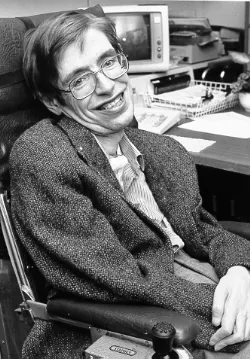
The clumsiness that had troubled Hawking in his final year at Oxford grew worse after he arrived in Cambridge. He fell on a flight of stairs, struggled with rowing, and his speech began to slur. Over the Christmas of 1962 his family noticed enough to insist he see a doctor. After a spell of tests in hospital early in 1963, shortly after his twenty-first birthday, he was given the diagnosis: amyotrophic lateral sclerosis, a form of motor neurone disease.
A two-year sentence
The prognosis was devastating. The doctors expected the disease to progress quickly, attacking the nerves that controlled his muscles until he could no longer move, swallow or breathe. They gave him around two years to live. He was twenty-one, newly arrived at Cambridge, at the very start of a research career, and he had just been told he would not live to finish it.
Hawking fell into a depression. He shut himself away, listened to a great deal of music, and for a while saw little point in continuing his work, since he did not expect to be alive to complete a doctorate. He later described a recurring dream from this period in which he was about to be executed, and how it made him realise that there were things worth doing if he were reprieved.
Two things that pulled him back
Two developments changed the course of those years, and with them his life.
The first was that the disease progressed far more slowly than anyone had predicted. The rapid decline the doctors expected did not come. As months passed and then years, it became clear that he had an unusually slow-moving form of the condition, possibly connected to its rare early onset. The time he had assumed was denied him was, against the odds, being granted.
The second was personal. Around the time of his diagnosis he had met Jane Wilde, a young woman studying languages. Their relationship deepened into an engagement, and Hawking later said it gave him something to live for. With the prospect of marriage, he needed a job; to get a job he needed to finish his PhD; and so, for the first time in his life, he began to work in earnest. The looming sense of an early death, rather than paralysing him, focused him. If his time was short, he reasoned, he had better do something worthwhile with it. He and Jane married in 1965.
A slow, decades-long progression
The disease never reversed, but it advanced with extraordinary slowness. Hawking walked with a stick, then needed crutches, and from the late 1960s used a wheelchair. His speech grew progressively harder to understand, until by the early 1980s only those who knew him well could follow it, often relaying his words to others.
The decisive turn came in 1985. On a trip to Geneva he contracted pneumonia and, gravely ill, underwent a tracheotomy to help him breathe. The operation saved his life but removed his ability to speak entirely. For a time he could communicate only by having someone point to letters on a card and raising his eyebrows at the right one. It was then that the computerised speech system that became his trademark was developed, allowing him to select words and have them spoken by a synthesiser, a system explored on the page about the voice.
An almost unparalleled survival
Hawking lived for fifty-five years after his diagnosis, dying in 2018 at the age of seventy-six. For a disease that usually proves fatal within two to five years, this is almost without parallel, and it is not fully explained even now. The likeliest medical explanation is the rare, slowly progressing, early-onset form of the disease he happened to have, combined with decades of exceptional care.
Whatever the cause, the consequence was profound. Hawking did virtually all of his most important physics, and became the most famous scientist in the world, in a body that the medical consensus had expected to fail by 1965. He never hid from the disease, but he refused to be defined by it, a stance explored further in his approach to how he thought and his lifelong support for motor neurone disease research.
This page touches on serious illness. If you or someone you know is affected by motor neurone disease, the MND Association offers information and support.
Living so long under an early death sentence shaped his outlook; see what Hawking thought about death.