Book · 1988
A Brief History of Time
The 1988 landmark that sold tens of millions of copies and put cosmology on bedside tables worldwide. What's inside, why it mattered, and whether to start here.
Last updated 23 May 2026 · How we research
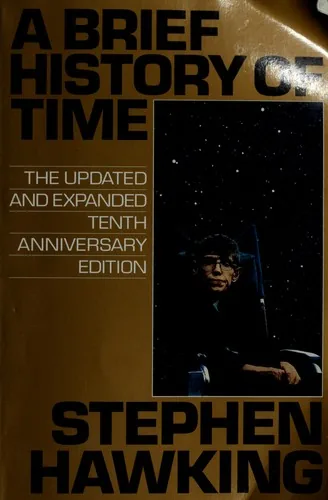
Book · 1988
A Brief History of Time
Stephen Hawking
The landmark bestseller that explained the universe to everyone, with just one equation.
View on Amazon →Or listen (audiobook) →Affiliate links, a share supports MND research.
It is the book that made Stephen Hawking a household name. Published in 1988, A Brief History of Time set out to explain the origin and fate of the universe to ordinary readers, and in doing so became one of the best-selling science books ever written.
What it covers
The book is a guided tour of the big questions in cosmology as they stood in the late 1980s. Hawking walks the reader through the expanding universe and the Big Bang, the nature of space and time, black holes and his own discovery that they radiate, the "arrow of time" and why it points the way it does, and the long quest for a single unified theory of physics. It famously closes with the suggestion that such a theory would let us know "the mind of God," a phrase Hawking used to mean the complete set of laws governing the universe rather than anything religious.
The one-equation rule
The most repeated story about the book concerns its mathematics, or near-total lack of it. Hawking's editor warned him that every equation he included would halve his sales. He took the advice seriously and included just one: Einstein's E = mc². The discipline this forced, finding words and images for ideas that physicists normally express in mathematics, is exactly what made the book accessible, and it reflects a conviction Hawking held throughout his life: that if you cannot explain something simply, you do not fully understand it.
Why it mattered
The commercial success was staggering. The book sold in the tens of millions, was translated into dozens of languages, and spent years on bestseller lists. It became a genuine cultural object, a fixture on bookshelves around the world and so widely owned that it earned a teasing reputation as a book more often bought than finished.
Its real importance, though, was that it democratised cosmology. It told millions of non-scientists that the deepest questions about the universe were theirs to think about too, and it turned a Cambridge physicist into a global figure. Almost every popular science book that followed owes something to the path it cut.
Who it's for, and where to start
A Brief History of Time is written for the ambitious general reader. It is genuinely accessible, but it does not pretend the ideas are easy, and some chapters reward a second reading. If you want the original and most influential statement of Hawking's vision, start here. If you would prefer a gentler, updated route in, the later A Briefer History of Time was written for exactly that purpose.
The first edition carried an introduction by Carl Sagan; the two communicators are compared in Hawking vs Sagan.